AI coding assistants can generate code instantly, but long-term success depends on context, architecture, and decision-making. Discover why modern developers must evolve beyond manual coding.

Applied AI focuses on how artificial intelligence is used in real business environments, not as theory, but as a practical capability. This category explores how teams apply AI to decision making, workflows, software systems, and operations, balancing speed, accuracy, and human judgment. The emphasis is on implementation, impact, and lessons learned, not tools for tools’ sake.
AI coding assistants can generate code instantly, but long-term success depends on context, architecture, and decision-making. Discover why modern developers must evolve beyond manual coding.

Vibe coding may work for prototypes, but enterprise AI demands governance, accountability, security, and business alignment to scale safely.

Your lead developer quit and left no documentation, backups, or transition plan. Learn how to assess risk, regain control, and protect operations.
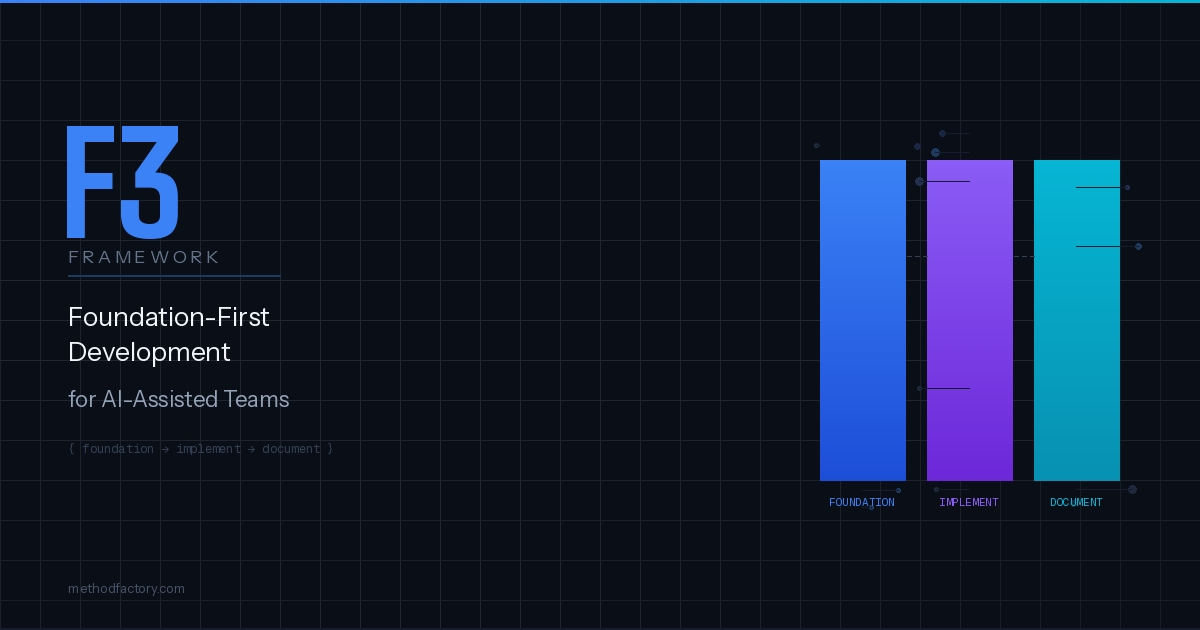
AI coding assistants are powerful, but without structure they forget your architecture, contradict past decisions, and drift from your conventions. The F3 Framework solves this by establishing a persistent foundation that keeps AI coders aligned with your project from the first session to the hundredth.

Quick Overview Modern AI development has changed what IT leaders can expect from engineering timelines. This article outlines how MethodFactory identified a new AI SEO requirement, built a complete llms.txt generator in one hour with Claude Code, and delivered a...

Quick Overview AI-assisted coding eliminates the classic “fast, cheap, good” trade-off by enabling rapid, high-quality software development. But this only works when guided by senior-level expertise, architectural discipline, and a clear understanding of how to direct...

Applied AI is the practical use of artificial intelligence to solve real-world business problems. Traditional AI focuses more on theory, research, and building the algorithms behind those tools. The difference is simple: applied AI delivers immediate business...

Quick Reference: Key Takeaways From library dependence to custom solutions: Before AI, non-developers had to rely on plugin libraries, which were often incomplete, bloated, or locked behind costly subscriptions. AI opens plugin creation to everyone: Today, even...

AI is transforming software development by automating coding, testing, and deployment. Businesses can now create custom applications faster and cheaper, empowering teams to build tailored solutions that fit their operations without relying on off-the-shelf software or...

Quick Reference: Key Takeaways AI code generators are co-pilots, not pilots: They accelerate development but require senior oversight to avoid poor architectural decisions. 90/10 Rule: These tools can deliver 90% of a project quickly, but the last 10% of debugging,...