
Quick Overview
Modern AI development has changed what IT leaders can expect from engineering timelines. This article outlines how MethodFactory identified a new AI SEO requirement, built a complete llms.txt generator in one hour with Claude Code, and delivered a solution that previously would have taken weeks.
How We Got Here
When the llms.txt specification was announced, it created a clear new requirement for organizations preparing for AI-driven discovery. Businesses suddenly needed a way to present structured, LLM-friendly information that answer engines and generative systems could use at inference time.
Traditionally, building an internal tool to support a new web standard would require cycles of scoping, design, development, iteration, and QA. IT leaders know the drill: the business asks for a solution, engineering spends weeks building it, and the final output still lands at about eighty percent of the original vision.
That model is already outdated. Using Claude Code, MethodFactory designed, coded, tested, and delivered a fully functional llms.txt creation app in one hour. This article documents that process and what it means for modern IT management.
Understanding llms.txt and Why It Matters
The llms.txt standard proposes a simple but powerful concept: give large language models a clean, structured, markdown-based reference file that summarizes a website in LLM-ready form. Unlike full HTML pages or raw sitemaps, llms.txt provides curated context such as:
- A clear description of the organization
- Service or product overview
- Key links to deeper, LLM-friendly markdown files
- Optional sections for extended context
As defined at llmstxt.org, the standard exists because LLMs cannot ingest entire websites at inference time. Pages are too long, full of HTML noise, and inconsistent in structure. llms.txt solves this by acting as a human and machine readable index designed specifically for AI consumption.
For IT leaders, this is now an operational need. LLMs are becoming an interface layer for users, which means organizations must prepare content for them just as they did for search engines.
Why This Matters in a BSA, AEO, and GEO Context
BSA Framework principles position llms.txt as a critical new authority signal for intelligent systems. The file strengthens all three modern search vectors:
For AEO (Answer Engine Optimization)
llms.txt makes the “direct answer” layer more accurate. When a user prompts an AI assistant with queries about your organization, that assistant can infer from concise, structured text instead of scraping unstructured pages.
For GEO (Generative Engine Optimization)
Generative engines prefer clear, trustworthy summaries. llms.txt becomes a citation-friendly anchor that AI models can draw from when generating synthesized responses.
For BSA Alignment
The llms.txt file creates a new form of measurable digital authority by providing LLMs with:
- A curated explanation of your brand
- Clean links to structured content
- Context that reinforces entity understanding
- A machine-parsable blueprint in markdown
In short, llms.txt is a new form of “answer-readiness”. Companies that adopt it early will see better performance in AI Overviews, answer engines, and generative outputs.
How MethodFactory Delivered a Full llms.txt App in One Hour
Once the llms.txt specification was published, MethodFactory immediately recognized that organizations would need a way to generate these files at scale. The traditional route would involve:
- API design
- UI wireframes
- Full-stack development
- Testing
- Multiple review cycles
Instead, MethodFactory used Claude Code to accelerate the entire process.
The One-Hour Build Process
Within a single working session, the team:
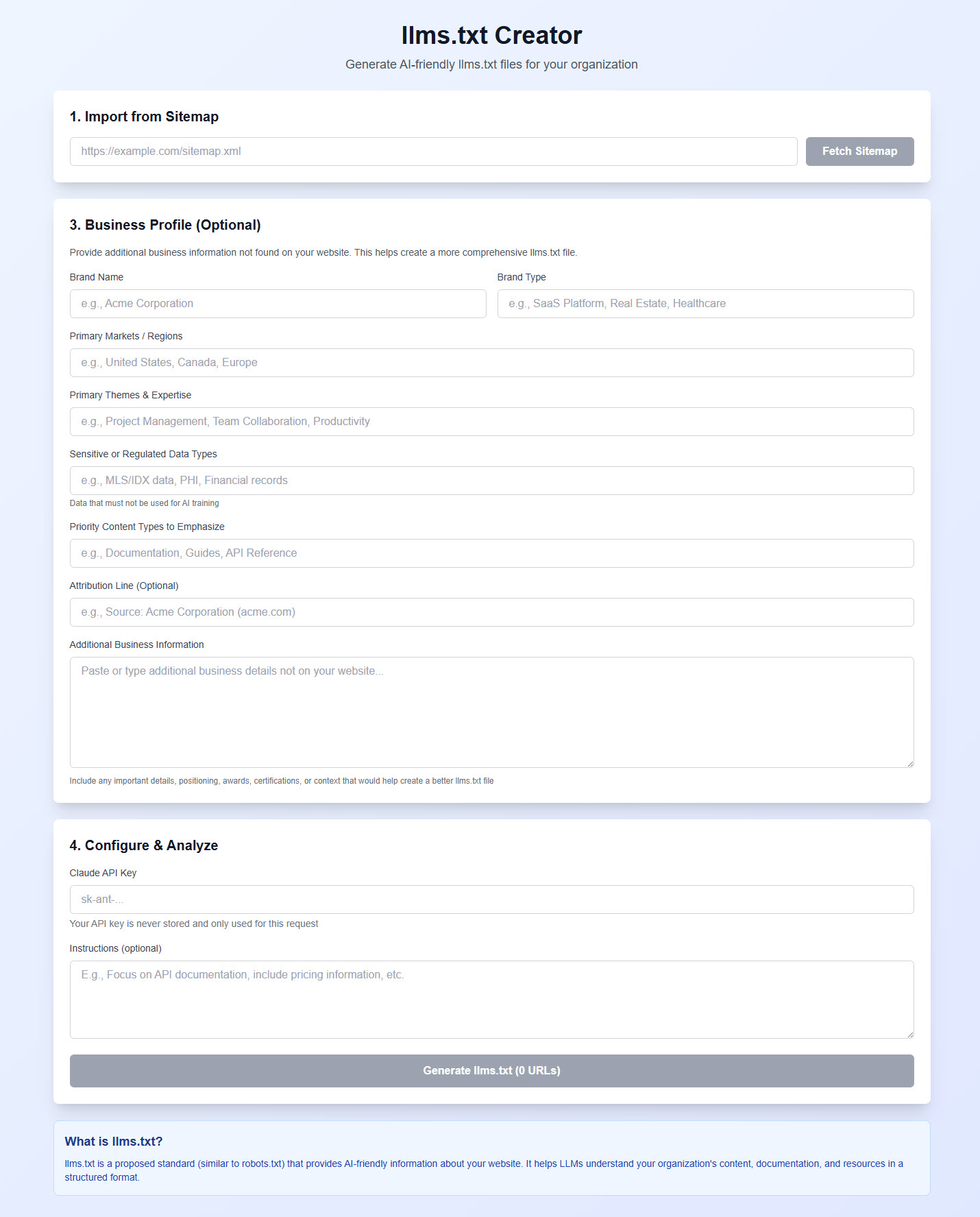
- Fetched and parsed live XML sitemaps from any provided URL.
- Created a dual-panel URL selector, enabling users to choose up to twenty URLs per llms.txt output.
- Added CSV import/export, allowing teams to automate workflows.
- Integrated a Claude API key field, so users could submit URLs for AI-powered analysis.
- Allowed optional instructions, enabling businesses to tailor the llms.txt output.
- Generated complete llms.txt files instantly and provided options to copy or download them.
A project that historically took weeks—requirements gathering, front-end development, backend architecture design, prompt engineering, testing, and polishing—was delivered precisely as envisioned in sixty minutes.
Why This Matters to IT System Managers
This shift demonstrates a new operational reality:
- Small internal tools that once cost weeks now take hours.
- Requirements can be implemented in real time as stakeholders watch.
- Business teams get the exact solution they asked for, not an approximation.
- Future enhancements can be added immediately instead of waiting for a sprint cycle.
This is the new pace of AI-enabled engineering.
Common Misconceptions About AI-Assisted Development
Many IT leaders still hold outdated assumptions about AI-driven software creation. Common misconceptions include:
- “AI coding tools produce unusable code.”
The opposite is now true when properly guided. Claude Code generated clean, production-ready components. - “Rapid builds are prototypes, not deployable tools.”
The llms.txt generator proves otherwise; the tool was fully functional on first delivery. - “You lose oversight or control.”
The developer still architects, guides, and validates. AI accelerates the implementation. - “This only works for simple tasks.”
UI creation, API integration, parsing logic, and markdown generation all occurred in the same session.
This case demonstrates that AI-assisted development is not a novelty. It is a capability shift.
How Organizations Should Approach llms.txt and AI-Era Development
To stay competitive in the age of AI-driven discovery, businesses should adopt two parallel strategies.
Implement llms.txt as Part of Your BSA Foundation
Every organization should create:
- A root-level llms.txt
- Supporting .md versions of key pages
- A clear LLM-readable summary of their brand
- Internal processes to update these files over time
This becomes a core part of AEO and GEO readiness.
Modernize IT Development Expectations
AI-assisted engineering allows teams to:
- Build internal tools significantly faster
- Deliver exactly what stakeholders ask for
- Reduce back-and-forth cycles
- Free senior developers from low-value implementation work
MethodFactory’s one-hour llms.txt creator is not an outlier. It is an example of what is now standard when teams combine domain expertise with AI engineering tools.
Validate Output Through BSA Principles
Whenever creating new digital assets, ensure they support:
- Entity clarity
- Direct answer readiness
- Generative citation potential
- Human-readable authority
llms.txt aligns naturally with all four.
Why This Shift Can’t Be Ignored
AI is reshaping how fast organizations can design, build, and deploy operational tools. When MethodFactory created a complete llms.txt generator in one hour, it demonstrated the new baseline that IT leaders should expect from modern AI-driven development.
If your team wants to explore llms.txt adoption, enhance your intelligent search readiness, or accelerate internal tool development with AI, MethodFactory can help you move at this new pace.
Ready to modernize your digital authority and implement AI-era development workflows? Let’s build your next breakthrough together.
Frequently Asked Questions
-
What types of code are safe to generate?
We use AI for scaffolding, tests, glue code, and suggestions. Core algorithms, security critical sections, and data handling always get human design and review.
-
Will AI replace my developers?
No. AI augments developers. Human expertise guides architecture, security, and innovation. Automation handles repetitive tasks under governance.
-
How do you prevent low quality code?
We enforce policies, run static and dynamic checks, and require human approval on protected branches. We also watch test mutation scores, not just coverage.
-
Can you work with regulated data?
Yes, with the right constraints. We keep sensitive data out of prompts, isolate environments, and apply strict access controls.
-
How fast can we see results?
Most pilots show measurable gains inside four weeks, including faster PR merges and higher quality scores.
-
What problems does AI-Assisted Coding solve?
It automates repetitive work, accelerates delivery, and maintains quality across large teams. This frees developers to focus on architecture and user experience. -
How quickly can we see results?
Most teams see measurable gains within weeks using our Foundation-First approach and a phased rollout. -
Can this integrate with our current systems?
Yes. We design integrations that fit your tech stack and policy requirements with clear oversight and auditability.
Build an Authority‑Driven Website
Align SEO, AEO, and GEO to become both the answer and the trusted source.