
Quick Read
Most AI coding tools forget everything between sessions. No memory of your architecture, conventions, or past decisions. Every conversation starts from zero.
The F3 Framework fixes this. Built by MethodFactory, F3 stands for Foundation-First Framework — a methodology that gives AI coders a persistent project context so they work with your codebase, not against it.
It works in three phases: Foundation (define your project’s truth), Implementation (build with AI that already understands your patterns), and Documentation (capture decisions so context stays current). Each session makes the next one better.
The result: consistent code, fewer corrections, faster delivery, and an AI teammate that actually gets smarter over time instead of starting over every morning.
The Context Gap
AI coding assistants like Claude Code, Cursor, and GitHub Copilot have fundamentally changed what is possible in software development. A solo developer can now build in a weekend what once required a full team and multiple sprints.
But most teams hit the same wall surprisingly quickly.
The gap between what AI can build and what it actually builds is enormous. That gap almost always comes down to one thing: context.
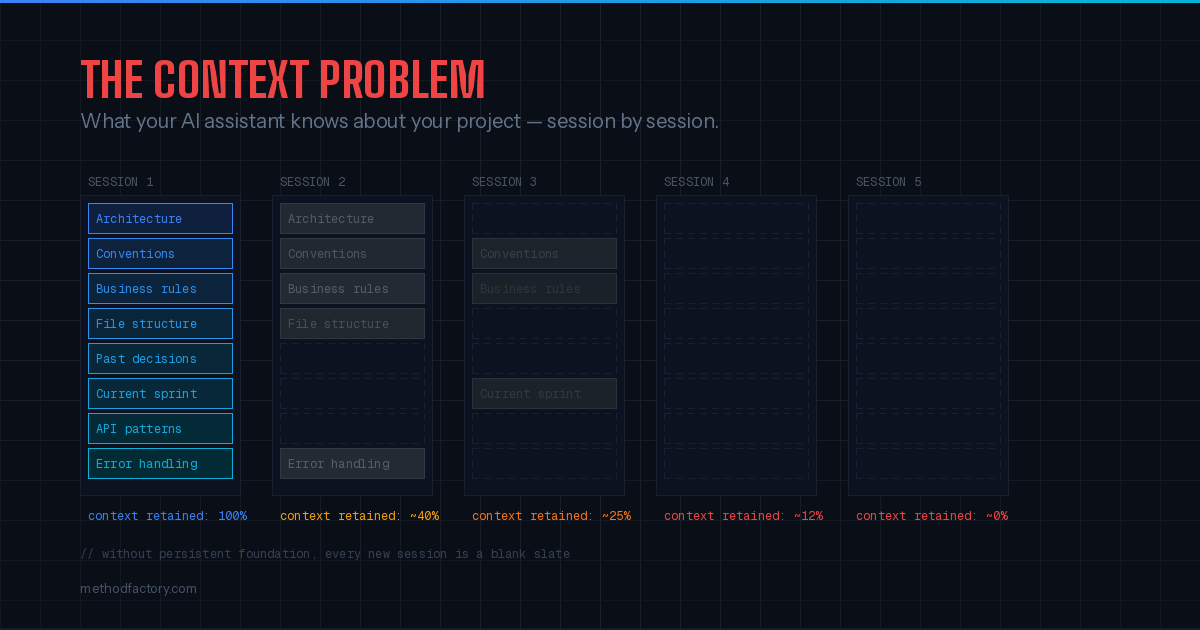
Without structure, working with an AI coder feels like onboarding a brilliant contractor who has amnesia. Every session starts from scratch. Every conversation requires re-explaining your architecture, your conventions, and your business logic. The AI produces elegant code that does not fit your project, reintroduces patterns you deliberately abandoned, or solves a problem you already ruled out.
The F3 Framework exists to close that gap.
What Is the F3 Framework? (Direct Definition)
The F3 Framework (Foundation-First Framework) is a structured methodology for AI-assisted software development that gives AI coding tools persistent, project-specific context through embedded documentation. It ensures architectural consistency, aligned decision-making, and compounding productivity across AI coding sessions.
Rather than treating AI as an autocomplete engine or a chatbot you argue with, F3 treats AI as a team member that needs proper onboarding and provides a system to do exactly that.
The framework was developed by MethodFactory based on decades of building, scaling, and maintaining real production systems where consistency and long-term maintainability matter.
The Core Problem F3 Solves
The first hour feels magical. You describe what you want and working code appears. By the second day, frustration sets in. The AI contradicts decisions it made yesterday. It introduces a new state management pattern when you already chose one. It names things inconsistently. It forgets that your API uses snake_case, not camelCase.
The root cause is not that the AI is bad at coding.
The root cause is that the AI has no durable understanding of your project beyond what fits inside its current context window. Every session is a blank slate unless you deliberately fill that slate with the right information.
Most teams attempt to solve this with longer prompts, pasted files, or manual cleanup after the fact. These approaches are all symptoms of the same mistake: trying to compensate for missing structure with more effort.
F3 is not a workaround. It is the structural fix.
The F3 Framework at a Glance
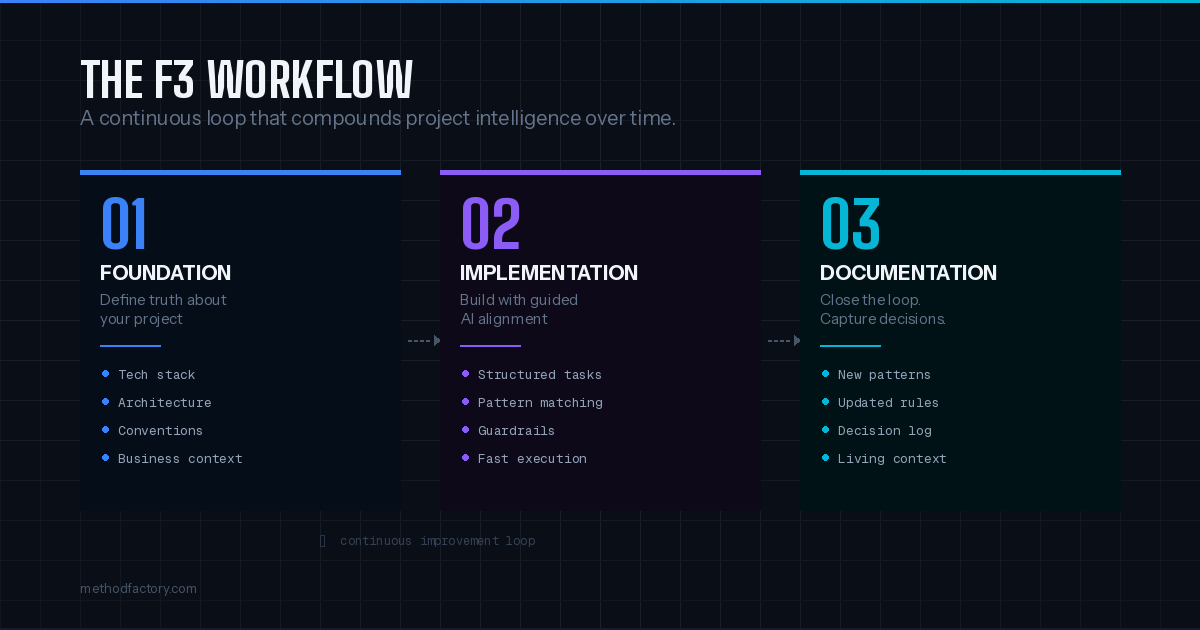
The F3 Framework is organized into three tightly coupled areas, each with a specific role in keeping AI-assisted development aligned over time.
Foundation
Persistent project truth: architecture, conventions, and business rules.
Implementation
Guardrailed execution patterns that guide AI output without constraining speed.
Documentation
A continuous feedback loop that keeps the AI’s context current as the system evolves.
Together, these create continuity across sessions, tools, and contributors.
Foundation: Onboarding Your AI Once, Not Every Time
This includes your tech stack, architectural patterns, file organization, naming conventions, error-handling strategies, and the business context behind key technical decisions. These are captured as structured documents that live inside your repository, not in a prompt library you have to remember to paste.
When an AI coding assistant starts a session, it reads these foundation documents automatically. Before you ask it to do anything, it already knows that your project uses Next.js with the App Router, that Zustand is your chosen state management layer, and that your API follows a specific error contract.
There is no re-explaining. There is no drift. The AI starts aligned.
Implementation: Guided Execution Without Micromanagement
Once the foundation is in place, implementation becomes a conversation with an AI that understands the environment in which it operates.
F3 provides structured task patterns that guide the AI through common workflows, including feature development, refactoring, debugging, and test creation. These patterns define expectations and constraints without turning the process into rigid templates.
You focus on the what and the why.
The AI handles the how, inside boundaries that already reflect your standards.
The result is speed without entropy.
Documentation: How Alignment Compounds Over Time
F3 treats documentation as an operational system, not an afterthought.
Every meaningful change feeds back into the foundation. New conventions, resolved architectural debates, and evolving patterns are captured explicitly. This ensures that the AI’s understanding of the project improves rather than decays as complexity increases.
Each session strengthens the next one. The AI becomes more useful over time, not less.
This is the opposite of the plateau most teams experience with AI coding tools.
Why the Difference Is Not Incremental
Consistency across sessions
With F3, the AI picks up exactly where it left off, following the same patterns regardless of time gaps or tool changes.
Faster onboarding for humans
The foundation documents are not AI-specific. They also function as onboarding material for new developers, ensuring architectural intent is documented once and retained over time.
Lower code review overhead
Reviews focus on correctness and edge cases rather than re-litigating style or architectural decisions.
Sustainable scale
As projects grow, F3 prevents AI output from fragmenting the system into incompatible patterns.
Who the F3 Framework Is Designed For
F3 is built for professional teams shipping real software.
It is particularly effective for organizations working on long-lived systems where maintainability, consistency, and architectural discipline are non-negotiable. That includes enterprise platforms, internal tooling, and complex customer-facing applications.
Solo developers building serious products benefit just as much. If you have ever spent more time fixing AI-generated code than writing it yourself, F3 addresses that exact failure mode.
This is not a framework for throwaway prototypes. It is a framework for work that has consequences.
The Bigger Shift Most Teams Are Missing
AI-assisted development is still early, and most teams are approaching it without a methodology. They bolt AI onto existing workflows and hope for the best. Some get lucky. Most hit a ceiling.
F3 represents a different posture.
It designs the workflow around how AI coders actually work, accounting for their strengths and limitations instead of fighting them. It does not require a new tech stack or a new IDE. It requires taking context seriously and managing it intentionally.
Teams that do this build faster, ship more reliably, and scale their output in ways teams stuck in blank-context prompting simply cannot match.
What to Do Next
If you are serious about using AI coders on production systems, the question is no longer whether AI can help. The question is whether you have given it the required structure to consistently help.
The F3 Framework is how teams do that deliberately, not accidentally.
The F3 Framework is a proprietary methodology developed by MethodFactory, a full-service digital solutions company helping businesses build smarter systems since 2000. To learn more about implementing F3 in your development workflow, connect with the MethodFactory team.
Frequently Asked Questions
-
What is the F3 Framework in simple terms?
The F3 Framework is a system for giving AI coding tools persistent, structured context so they behave like informed team members instead of stateless assistants. It replaces ad hoc prompting with embedded project documentation that keeps AI output aligned over time. -
How is F3 different from prompt engineering?
Prompt engineering optimizes individual interactions. F3 optimizes the entire working relationship. Instead of rewriting context into every prompt, F3 establishes a durable foundation the AI reads before any task begins, ensuring consistency across sessions. -
Do I still write prompts when using F3?
Yes, but the prompts are shorter and more focused. With F3, prompts describe what you want and why, not your entire architecture or conventions. The AI already knows those from the foundation documents. -
What does F3 stand for?
F3 stands for Foundation-First Framework. The name reflects the core principle that effective AI-assisted development starts with establishing a solid project foundation before writing any code. -
Which AI coding tools does F3 work with?
F3 was designed primarily for use with Claude Code, but the methodology applies to any AI coding assistant that reads project context, including Cursor, GitHub Copilot, and similar tools. The better the tool is at ingesting structured documentation, the more value F3 delivers. -
Is F3 an open-source framework?
No. F3 is a proprietary methodology developed by MethodFactory. It's available to teams and organizations through MethodFactory's consulting and implementation services. -
Do I need to change my tech stack to use F3?
Not at all. F3 is stack-agnostic. It works with whatever languages, frameworks, and tools your team already uses. The framework operates at the methodology layer, not the technology layer. -
How long does it take to set up F3 on an existing project?
Most teams can establish a working foundation in a single focused session. The initial setup involves documenting your architecture, conventions, and key business context. From there, the foundation grows organically as you build. -
Does F3 work for solo developers or only teams?
Both. Solo developers often see the fastest ROI because they're the ones most likely to lose context between AI coding sessions. F3 gives a solo developer the continuity that a team would normally provide through shared knowledge. -
What's the difference between F3 and just writing better prompts?
Prompt engineering is per-session. You write a good prompt, get a good result, and start over next time. F3 creates persistent, project-level context that carries across every session automatically. It's the difference between giving someone directions each morning and giving them a map they keep forever. -
Can F3 be applied to projects already in progress?
Yes. F3 works for both greenfield and existing projects. For projects already underway, the Foundation phase captures your current architecture and conventions so the AI can work within what's already been established rather than introducing competing patterns.
Align SEO, AEO, and GEO to become both the answer and the trusted source.